Thursday, September 30, 2010

Veni Vidi Veneto


Nadia Zenato’s upcoming visit to Shubie’s reminded me of a couple things:
  • I love Zenato’s wines. 
  • The best radicchio I have ever tasted!
  • I love the Veneto region of Italy, where the wines come from. 
I was lucky enough to spend a 6 or 7 days in the region once, and they were some of the best days I ever spent in Italy. The weather was perfect—despite the fact that it was the middle of January. The landscape was picturesque everywhere I went. The food was, of course, fantastic—I still think longingly of the loose-leaf Radicchio di Treviso that they grow there (yes, after five years, I still think about the radicchio—it was that good!) And I got to visit Zenato’s estate.

Conditions were perfect for tasting their amazing wines, but even now, on a dreary New England day in October, without a Roman ruin or piece of radicchio in sight, I still love to drink them. Here are some of the highlights: 

Grapes drying to make Amarone
  1. Zenato Lugana: Zenato’s winery is located on the southern end of Lake Garda. Aside from being one of the most picturesque places in all of Italy, this is a perfect place for growing the local Trebbiano di Lugana grape, which is what they use to make the local Lugana wine. It's a wonderfully fresh, soft, floral white, and Zenato has done a lot to bring it out of the depths of obscurity. Pinot grigio fans beware—this could be a new favorite.
  2. Zenato Valpolicella (pronounced “val-po-lee-chel-a”): Made from indigenous grapes grown in the Valoplicella region, a little bit east of Lake Garda, this light red is a classic from the Veneto. With notes of cherries, violets, and even almonds, it’s great with chicken and polenta. Actually, it's good for just about any occasion--a perfect "house red" for anyone tired of pouring cabernet or pinot noir.
  3. Zenato Amarone: The granddaddy of wines from the Valopolicella, made by drying the grapes out for four months or so before crushing them. This yields an incredibly rich, powerful wine, with dense dark fruit flavors, and notes of dried fruit, smoke and spices. These are amazing wines that can be cellared for many years (if you have the patience). 
Because so much of the the grape is lost to evaporation in the process, though, Amarones are pretty expensive wines. If you want to get a feel for what Amarone is all about without spending the big bucks, you can try Zenato’s Ripassa. To make this, they take the regular Valpolicella and add the left over pommace from the Amarone, giving the wine an Amarone-like character, without an Amarone-like price!

Lake Garda

Thursday, September 23, 2010

Shubie's Global Community of Flavors

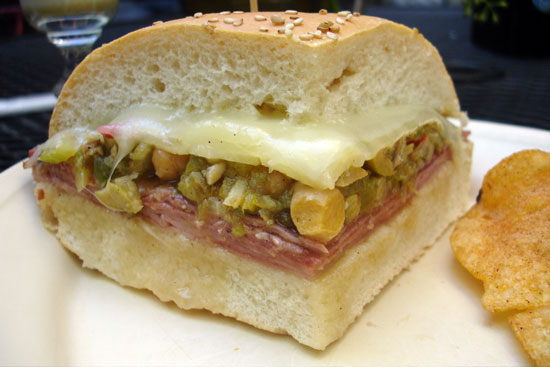
Chef Lynne's latest addition to the FoodBar menu, the Marblehead Muffuletta sandwich, got us thinking about how incredibly global our selection is. At any given time throughout the year, you could order Middle Eastern Falafel, an array of Asian Noodle Soups, a classic New York Reuben, Bahn Mi (a Vietnamese-style sandwich), a bowl of gazpacho, and even our own Local Cobb Salad Wrap, stuffed with a slew of locally grown veggies. It's a truly global community of flavors and recipes, right here in Marblehead!

And now joining that community is Chef's own take on the Sicilian-inspired sandwich from the Central Grocery in New Orleans.

For those of you not lucky enough to have tried one, a Muffuletta sandwich is typically made with an array of Italian cold cuts, sliced Provolone, and the key ingredient: a chopped olive salad, with cauliflower, celery and carrots, all steeped in olive oil and some vinegar. Put it all between two slices of muffuletta bread (a hearty Sicilian sesame bread that gives the sandwich its name), and you've got yourself a sandwich big enough to keep you fed all week!

As I said, the sandwich originated in the early 1900s at New Orleans' famous Central Grocery, a market in the French Quarter. As the story goes, Sicilian immigrant farmers selling their produce in the city would come to Central Grocery for lunch. They'd buy muffuletta bread, some cold cuts, cheese, and an olive salad, and then eat everything separately, balancing their small plates precariously on their knees while they sat. The store's owner, Salvatore Lupo, a Sicilian immigrant himself, noticed this and thought it might be easier for them if they sliced the bread and put all the fixings in between. He started making the sandwich, and pretty soon, everyone simply asked for "the Muffuletta."

The Muffuletta is now a staple in New Orleans, a must for all visiting tourists. Unfortunately, it's always been hard to find a good Muffuletta here in the Northeast--until now! Chef Lynne has put her own twist on this classic, and it's too good!

She starts with her one-of-a-kind olive salad, made in-house with her own special blend of herbs and olive oil, carrots, celery, and curried cauliflower (yes, curried--the sandwich now spans three continents!) Add this to a ciabatta stuffed full of sliced  prosciutto, salami, mortadella, provolone and a few leaves of radicchio (no muffuletta bread--those sesame seeds make such a mess!) and you've got another irresistible addition to our global community of flavors at the FoodBar.

Thursday, September 16, 2010

Music for Your Mouth

If you read DeMorgenzon's website, the first thing that will probably jump out at you is the fact that they play Baroque music to their vines and wine. Yes, that's right: every bottle of DeMorgenzon's wine has been "listening" to Bach, Haydn, Mozart, and many others from vine to bottle. They cite a number of studies that draw positive connections between music and plant growth.
It's a fun story--and certainly a memorable tidbit that will be fun to bust out at cocktail parties--but there's another method of winemaking that they talk about that really caught my attention. The vineyards are right in the middle of one of South Africa's greatest ecosystems, and they are actively encouraging this ecosystem to flourish within the vineyards (they've also set aside 10% of the estate to a nature conservancy, to preserve this biodiversity). This is where DeMorgenzon's real virtuosity lies.
Modern agriculture is all about growing only the crop you're trying to grow, and basically eliminating the rest. This is where we get all those pesticides, weed-killers, and other chemicals that are starting to sound so scary. The idea was to make it easier to grow the crops without all that other stuff getting in the way.
Of course, we're starting to learn that there are some consequences to these methods, and so a lot of winemakers have turned to biodynamics as an alternative to these farming techniques. I won't bore you with the details of biodynamics, but the principle behind is pretty fascinating: it treats farmland, including the land's natural habitat, as a living organism, and so everything that's a part of this land must be encouraged to flourish in harmony. So if you kill off all the beetles, or wipe out all the weeds, it's like cutting off an arm or a leg--the land will survive, but it will be crippled.

Winemakers who have turned from chemical treatments to biodynamics report amazing changes. The vineyards "come back to life," they say. The vines become healthier as other plants and animals return to replenish the soil with lost nutrients--in essence, the vineyard becomes an ecosystem again. The upshot is that healthier vines produce better wines! It's no surprise that many of our favorite wines at Shubie's are made by producers that employee biodynamic practices.

I should make it clear that DeMorgenzon doesn't claim to be a biodynamic producer. There's a lot that goes into biodynamics (including some practices that seem a little hocus-pocus, like harvesting according to moon cycles), and it may simply be that they don't want to employ all of tenets of biodynamics (I haven't had a chance to ask them about this myself). However, their main goal is essentially the same: encourage biodiversity within the vineyard. It's a wonderful philosophy, and there's a vibrancy to their wines that I like to think comes from the health and vitality of their vineyards. And I bet the music helps, too!

Go to their website to read more about their farming practices, and the amazing things they're doing to preserve what sounds like a truly remarkable ecosystem (after reading it, I certainly want to visit!)

Followers